
18 Years of Getting Found: Shaping the Future of Search and AI Visibility
On August 8, 2008, Metrik Marketing opened its doors.
In digital marketing, 18 years can feel like a century. At the time, Google was still relatively young, smartphones were new and SEO often relied heavily on repeating keywords.
Since then, platforms have appeared and disappeared, algorithms have changed and the way people find businesses has become far more complex. Through every shift, Metrik’s focus has remained consistent: helping businesses get found and building strategies that are shaped by time and built to last.
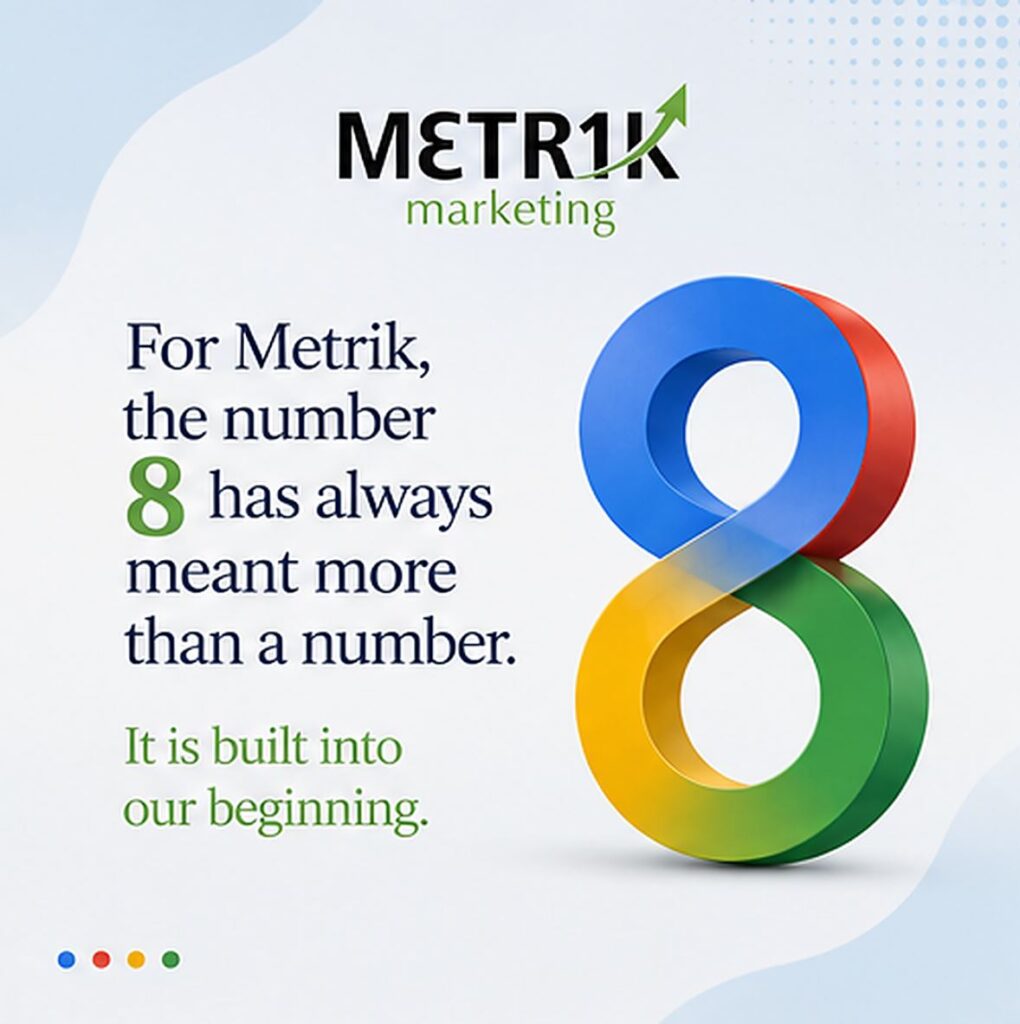
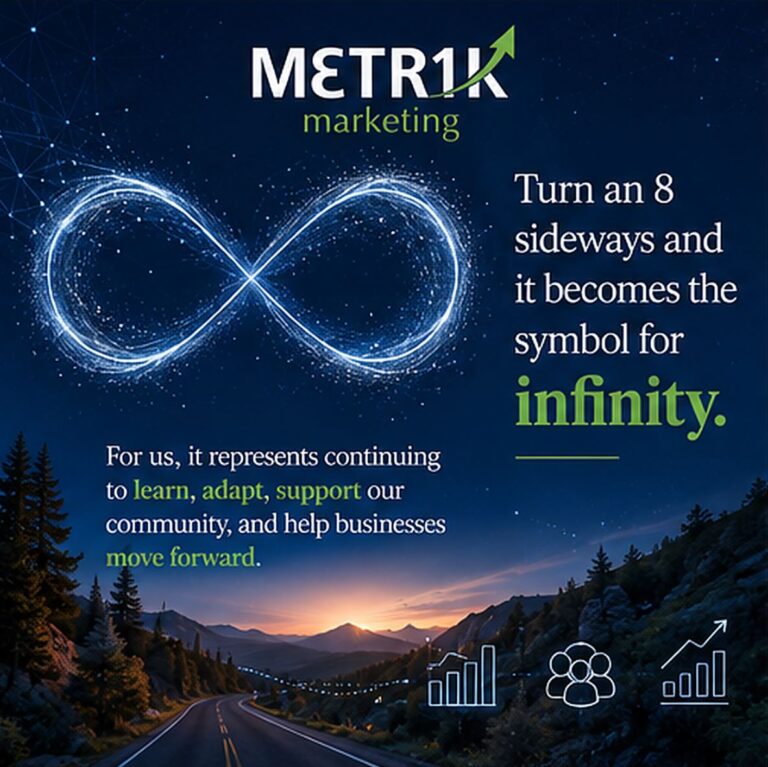
Our history has always been connected to the number eight. Metrik began on 08.08.08. The number eight represents consistency and momentum. Turned on its side, it also becomes the symbol for infinity.
That connection reflects the reality of digital marketing. Visibility is never finished. It must continue to adapt as technology, platforms and customer behaviour change.
Growing Alongside Our Clients
Over the past 18 years, Metrik has had the opportunity to grow alongside organizations that understand the value of long-term marketing.
Our work over the years has involved supporting non profit organizations such asHeritage Park, which has included creative initiatives including Cars of the Big and Small Screen, a temporary exhibit featuring recognizable vehicles from film and television. These advanced projects also involved collaboration with partners such as Tourism Calgary to promote hotel packages connected to the exhibit.
Another important relationship has been with MaKami College, which is celebrating its 25th anniversary. MaKami has grown exponentially from a single massage therapy school into a multidisciplinary institution offering programs across healthcare, wellness, education, business and continues to grow year over year.
Working with growing organizations requires more than repeating the same marketing plan each year. Their audiences change, their services expand and their goals evolve. The strategy must evolve with them.
That has always been an important part of Metrik’s approach. We do not simply work for our clients. We grow with them.
The Meaning Behind 08.08.08
Metrik’s story has always been closely connected to the number eight.
We began on 08.08.08, making the number part of Metrik’s identity from the very beginning. It represents consistency, momentum and continued progress.
Turn an eight sideways and it becomes the symbol for infinity.
For Metrik, that represents the ongoing nature of digital marketing. Visibility is never something a business completes once and keeps forever. Platforms change. Customer behaviour changes. Search engines change. Competitors change.
Businesses must continue learning, improving and moving forward.
Always Be Changing
One idea has guided Metrik through every stage of its history:
Always Be Changing.
Change is not simply an industry buzzword for us. It is part of how we work.
Our founder, Kita, has a tattoo of the Fundamental Theorem of Calculus. Calculus is the mathematical study of continuous change, making it a fitting reminder that change is not something to avoid. It is something to understand and work with.

That problem-solving mindset began before Metrik was founded.
Working in a shoe repair shop taught the physics and patience involved in craftsmanship. Sizing watches at jewellery stores at West Edmonton Mall including at The Bay required accuracy and attention to detail. Managing dental X-ray records helped build a strong foundation in Microsoft Excel and data organization.
Although these experiences came from different industries, they helped shape the way Metrik approaches marketing today: understand the details, use the information available and continue improving the process.
Metrik has also stayed connected with the companies shaping the digital industry. To recognize our 18th anniversary and our connection to the number eight, Kita is visiting Google’s Montreal office for Metrik’s eighth official Google office visit.
Previous visits have included Google offices in Mountain View, Boston, Toronto and Dubai. These visits help us stay connected to the platforms influencing how businesses are discovered online.
In a recent feature for Brand Magazine, Kita discussed the importance of Securing Your Digital Legacy. The piece examines the necessity of a robust succession strategy to safeguard access to vital online properties, including social accounts and advertising channels. This perspective aligns with our commitment to ensuring that a brand’s visibility is complemented by digital security that is built to last.
Search Is Becoming a Conversation
The digital marketing industry is now experiencing another major change: the shift from traditional search engines to AI answer engines.
Customers are no longer only typing a few words into Google and reviewing a page of links. They are also asking ChatGPT for recommendations, reading Google’s AI Overviews and using platforms such as Perplexity to research their options.
Instead of searching for “best accounting company,” someone may ask:
“Which accounting company is best for a growing Canadian business that needs bookkeeping and tax planning?”
The AI platform may then summarize several companies, compare them and recommend which ones appear most relevant.
This means businesses must think beyond traditional search rankings. They need to make sure their online information is clear, consistent and trustworthy enough for AI platforms to understand and potentially include in their answers.
GEO in Plain Language
GEO stands for Generative Engine Optimization.
In simple terms, it means organizing and improving your online content so AI platforms can easily understand it and use it when answering questions.
A website that only says, “We provide excellent service,” gives both customers and AI platforms very little useful information.
A stronger website clearly explains:
- What the company does
- Who it helps
- Where it operates
- What makes it different
- Why customers should trust it
GEO is not about filling a website with technical language or repeating keywords. It is about answering real questions clearly and providing useful information that can be understood by both people and AI.
LLMO in Plain Language
LLMO stands for Large Language Model Optimization.
While GEO focuses on making individual content easier for AI to use, LLMO focuses on helping AI platforms understand the business as a whole.
An AI platform should be able to recognize what your company does, who it serves, where it operates and why it is credible.
That understanding comes from consistency across your website, business profiles, reviews, articles, directory listings and other online mentions.
A simple way to explain the difference is:
GEO helps AI understand your content. LLMO helps AI understand your brand.
Both are becoming increasingly important as customers rely more heavily on AI when researching businesses and making buying decisions.
The AI-Amplified Marketer
AI is also changing paid advertising.
Advertising platforms can now automate bidding, suggest audiences, generate ad variations and quickly analyze large amounts of campaign data.
These tools can improve efficiency, but they do not replace strategy.
AI does not automatically understand which services are most profitable, which leads are most valuable or what matters most to a specific business. It can only work with the information it receives.
This is why Metrik follows the principle of the AI-Amplified Marketer.
AI supports the work. Experienced marketers still provide the direction.
By automating repetitive tasks, AI gives our team more time to focus on campaign strategy, business context, creative decisions and the quality of the leads being generated.
Different platforms also support different parts of the process. Claude can assist with complex information and messaging. Gemini and Copilot connect with their wider technology ecosystems. Perplexity can support research and citation analysis.
We also use tools such as Optmyzr, Competely, CapCut, Canva, Screaming Frog and Similarweb to support paid advertising, research, creative production and website analysis.
The goal is not to use every tool available. It is to choose the right tool for the task and apply it with experienced human judgment.
Why 18 Years of Experience Still Matters
New agencies can quickly adopt terms such as “AI SEO,” but genuine authority cannot be created overnight.
Modern search platforms look for signals of real experience, expertise, authority and trust. AI platforms also depend on clear, credible and consistent information when deciding which businesses to mention.
Metrik’s advantage is not simply that we use AI tools. It is that we combine them with 18 years of experience in search, advertising, analytics and client strategy.
That experience helps us separate meaningful industry changes from temporary trends. It helps us understand which numbers represent real business growth and which ones simply look impressive in a report.
Technology will continue to change, but strong strategy, clear communication and an understanding of customer behaviour will remain essential.
The Next Chapter of Search Starts Now
For 18 years, Metrik Marketing has helped businesses adapt to changes in search, advertising and customer behaviour.
The next stage is already here.
Customers are no longer only searching for businesses. They are asking AI platforms which businesses they should trust.
The companies that succeed will be the ones that are clear, credible and easy to understand.
After 18 years of helping businesses get found, Metrik is ready to help clients become part of the answers customers receive next.
Where Does Your Business Stand When Buyers Ask AI?
Prospective customers are already using AI platforms to compare companies and decide who they should contact.
Take five minutes Ai visibility self test to see how your business appears across AI platforms (try ChatGPT, Google Gemini, Claude (Anthropic), Grok, Perplexity, CoPilot):
- Ask Ai tools for the best providers in your industry & city
- Search your company name to check whether the information is accurate.
- Compare your business with a competitor to see which one AI recommends.
- Check whether ai Platforms like Perplexity or Copilot cites your website or reviews.
- Try a free scan with the HubSpot AEO Grader or Ahrefs AI Visibility Checker.
- Consider setting up a custom channel group in your GA4 to track all AI Search traffic, not just the newly announced AI Assistant results.
Keep in mind that your ai visibility is constantly changing and results may not be as stable as your SEO rank results.
Need help with AI visibility? Contact m3tr1k.com